.svg)



The Challenge
A hybrid policy exposed a mismatch between the company’s real estate footprint and how employees actually worked. Core offices held up; smaller regional locations did not. Field teams rarely used assigned spaces, costs persisted, and portfolio decisions continued to be made on assumptions rather than evidence.
Key constraints included:
- Underutilized regional offices.
Persistent overhead with no corresponding employee demand. - Inconsistent utilization patterns.
Attendance varied significantly by day — 70% midweek, 25% Fridays. - Lack of behavioral visibility.
No reliable signal for where employees actually needed to be. - Rigid lease commitments.
Long-term agreements prevented rapid optimization.
Traditional approaches — downsizing or consolidating — would still rely on incomplete information. The company needed a way to both reduce waste and generate a reliable signal of future demand.
The Solution
The company executed a two-phase strategy: replacing fixed regional offices with on-demand access to support the company’s meeting needs and to generate real behavioral data, then progressing to private hubs in markets where that demand had already proven itself at scale. Both phases ran on LiquidSpace’s Workplace Platform, which meant on-demand access, behavioral data capture, multi-market suite placement, and private office access at every scale all moved through a single system rather than fragmented processes.
Phase 1: On-Demand Access + Behavioral Data Capture
The company replaced fixed regional offices with a nationwide network of on-demand workspaces, giving employees access to thousands of venues where they actively use over 500 locations. Every booking generated a data point: which city, which space type, which employee, and how often.
Adoption reached steady-state by Q3 2023 and sustained above 1,500 bookings per quarter across most of the program period — confirming habitual use, not experimentation.
Employees accessed 6 distinct space types across the program. The mix reveals how a distributed workforce actually works:
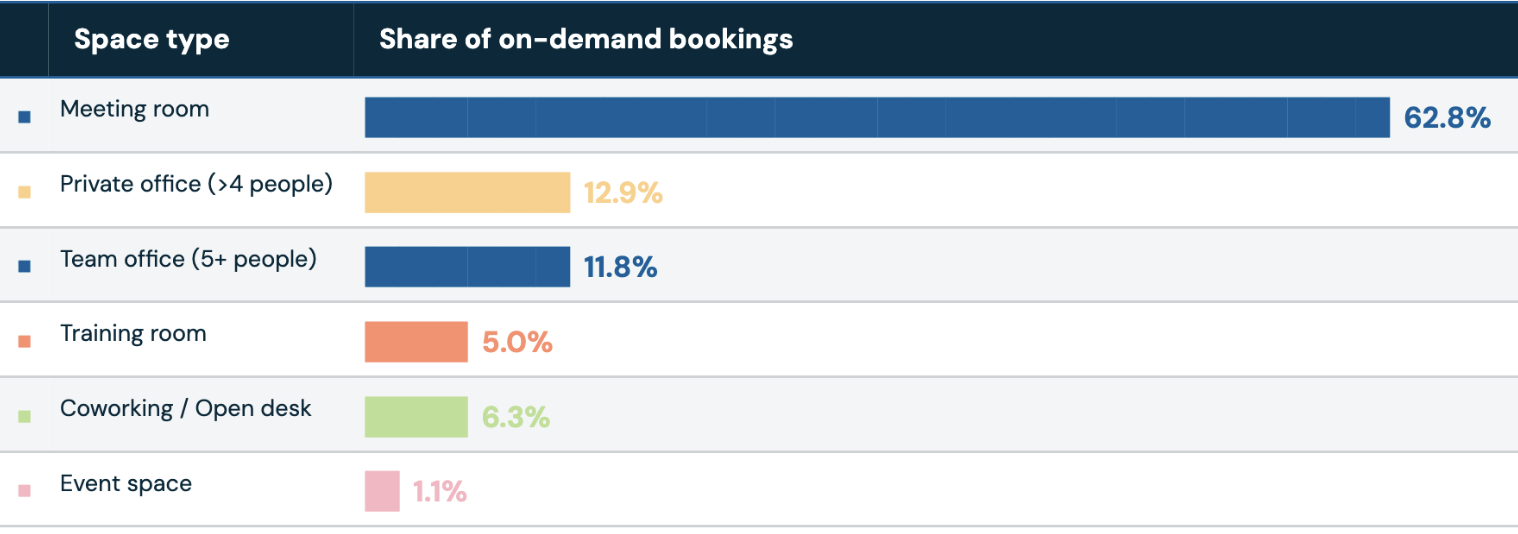
A second pattern emerged within individual markets. In California, employees booked across 181 venues in 75 cities; in Florida, 90 venues across 42 cities. Given a choice, employees did not converge on one or two convenient locations — they spread across dozens of venues throughout each region. This is the clearest evidence of what a network actually delivers: workspace where people already are, not where a single fixed address assumes they should be.
On-demand booking activity grew rapidly from program launch and held consistently, demonstrating habitual use across the organization:
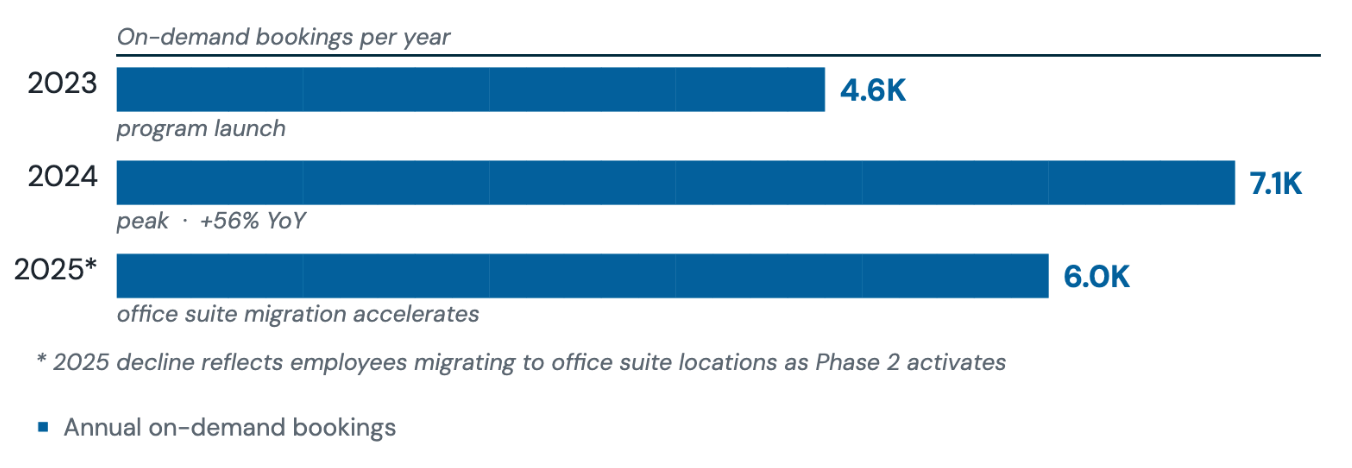
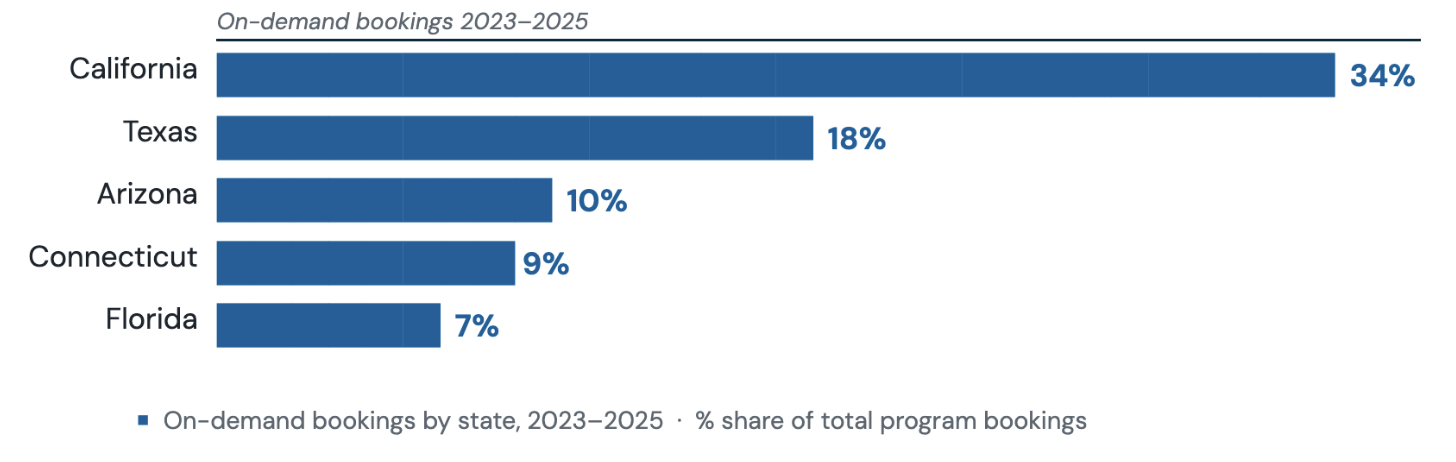
By the end of 2025, booking data had surfaced a clear geographic pattern: the program operated across 40 states, with 77% of all on-demand bookings concentrated in just five of them. This was behavioral evidence, not projection — and it became the direct input to Phase 2 office suite placement decisions. The same demand signals Hub Locator is built to surface.
Phase 2: Demand-Validated Private Office Suites
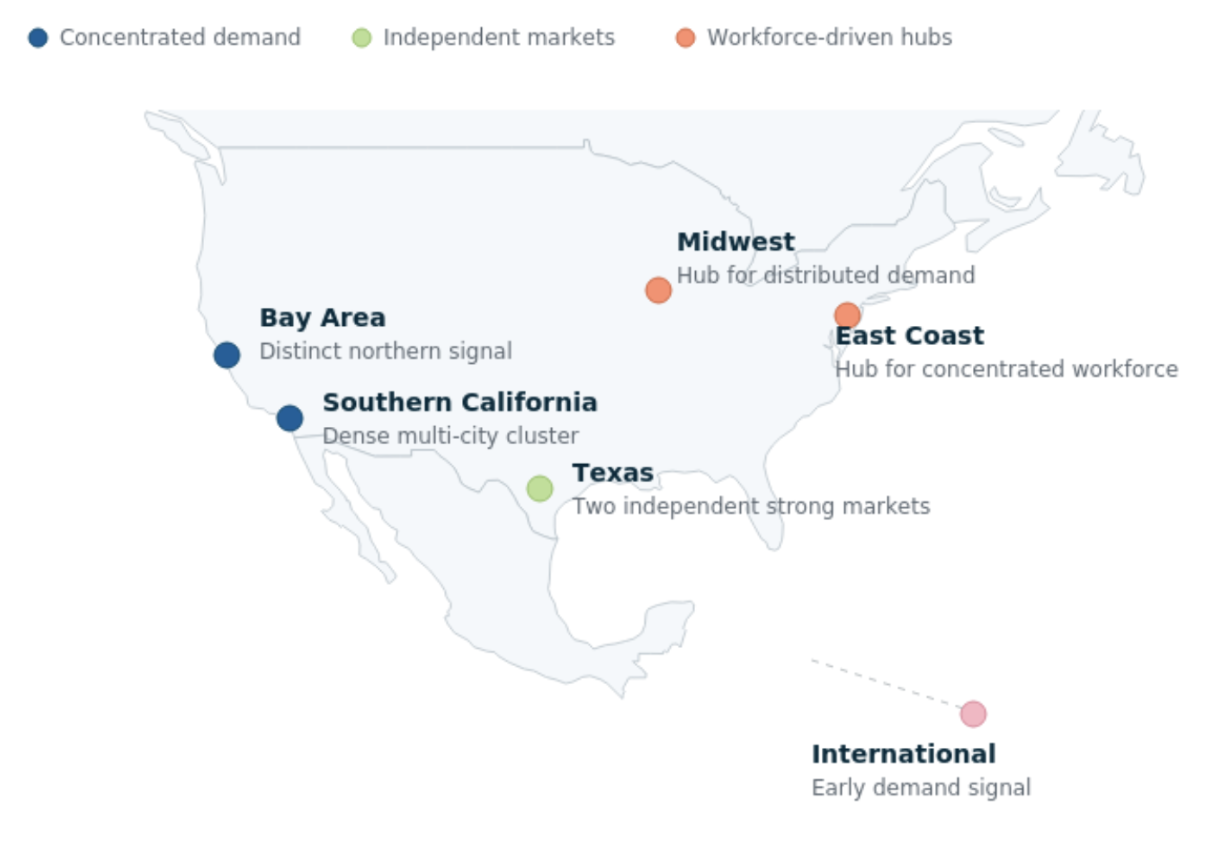
With three years of behavioral evidence in hand, the company transitioned from observation to action. Rather than rebuilding a fixed portfolio based on headcount projections, it procured private office suites — blocks of enclosed offices leased together — only in the markets where on-demand demand had already been sustained, sizing each suite against actual booking volumes in that market.
The on-demand program continues alongside it: employees in hub markets gain a consistent home base of private offices while retaining access to the broader network for meetings, training, and events, while employees in non-hub markets retain full on-demand access unchanged. Each suite transaction can now move through a structured workflow in Transaction Manager — intake, sourcing, and execution tracked in one place rather than across email threads and broker relationships — with obligations and renewal windows automatically available in License Administrator, giving the real estate team a single view of commitments across all active markets.
Phase 3: Some Sub-Markets Self-Serve
While Phase 2 addressed markets where demand had concentrated at scale, a separate pattern was already underway. Employees in cities where on-demand bookings hadn’t reached the threshold for a regional team hub — secured private offices through the platform on month-to-month terms, without a formal company directive to do so.
For each, Scenario Modeler is able to provide the insight to evaluate whether on-demand access remained the right answer or whether a committed private office was warranted. The platform supports both scales from the same infrastructure: a block of offices across eight cities for the sales team, a single private office in Miami for the employee who needs one.
The Results
The impact was swift and significant:
Portfolio cost transformation:
Exiting underperforming regional leases and replacing them with on-demand access reduced real estate costs by 80% within the first program year, while maintaining full workforce coverage. Every dollar tied to actual employee demand.
Behavioral intelligence at scale:
Three years of on-demand bookings across 516 employees, 840 venues, and 40 states produced a precise map of where and how this workforce actually operates. Adoption reached steady-state by Q3 2023 and averaged approximately 11 bookings per employee per year — confirming habitual, not occasional, use.
Precision office suite deployment:
The program reached 40 states, with 77% of all on-demand bookings concentrated in five of them. That concentration — generated by employee behavior, not planned by real estate teams — became the direct basis for office suite placement decisions. The company avoided overbuilding by investing only in markets with sustained, proven demand.
A portfolio model built to keep evolving:
The program didn’t end when the office suites opened. Enterprise suites serve the markets where portfolio-scale demand is proven; private offices serve employees in markets where no regional team hub exists; on-demand access covers everyone else. As new markets develop, booking data keeps generating the signal for where the next suite should go. The portfolio adjusts continuously — adding permanence where demand earns it, preserving flexibility everywhere it’s still needed. Several markets are currently in active negotiation, identified directly from on-demand booking patterns.